
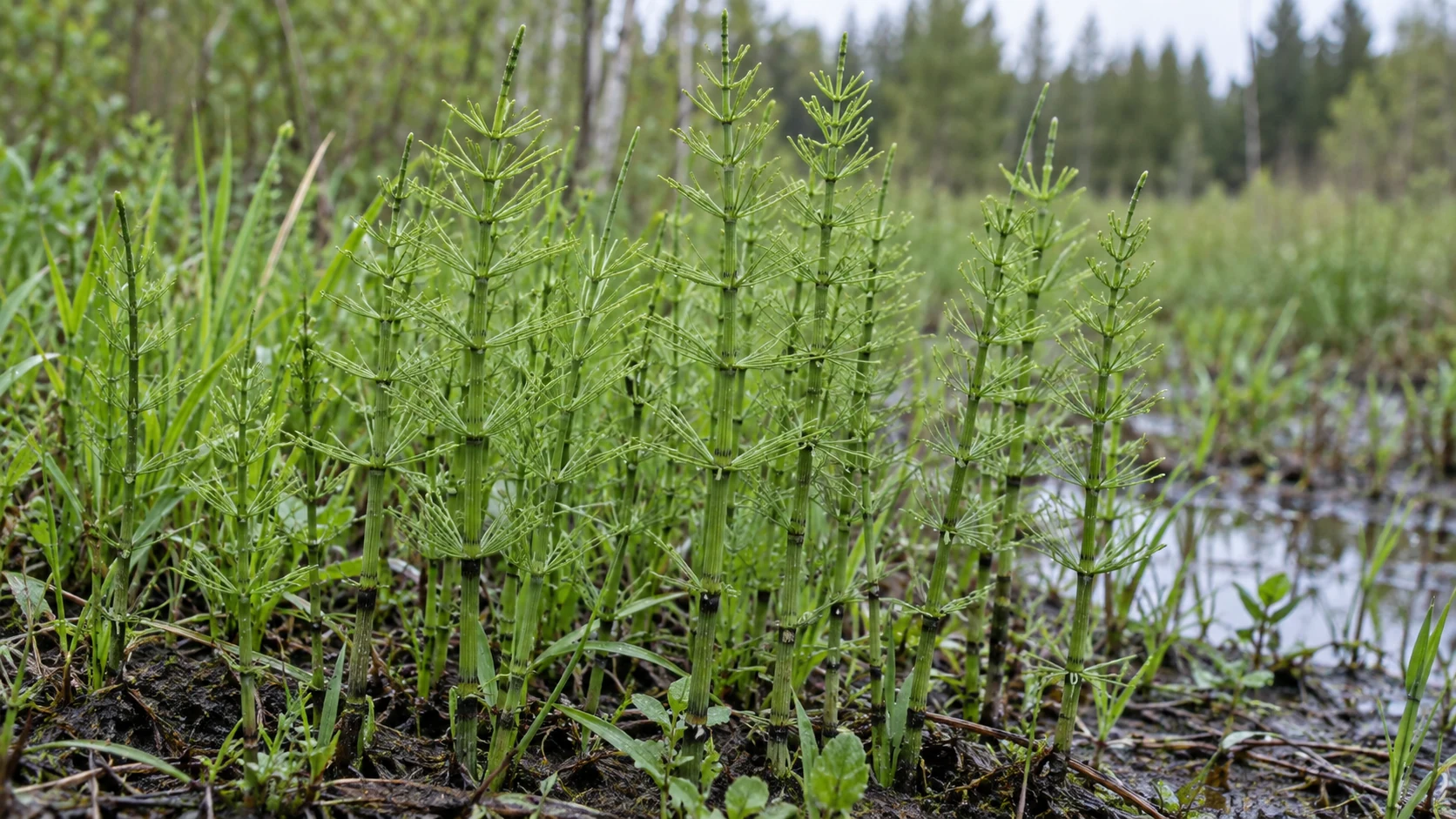
Field horsetail
Equisetum arvense
common horsetail, horsetail
Based on the courses of Églantine Vignon, Master Herbalist Updated
How to identify field horsetail
What to check before harvesting or using it.
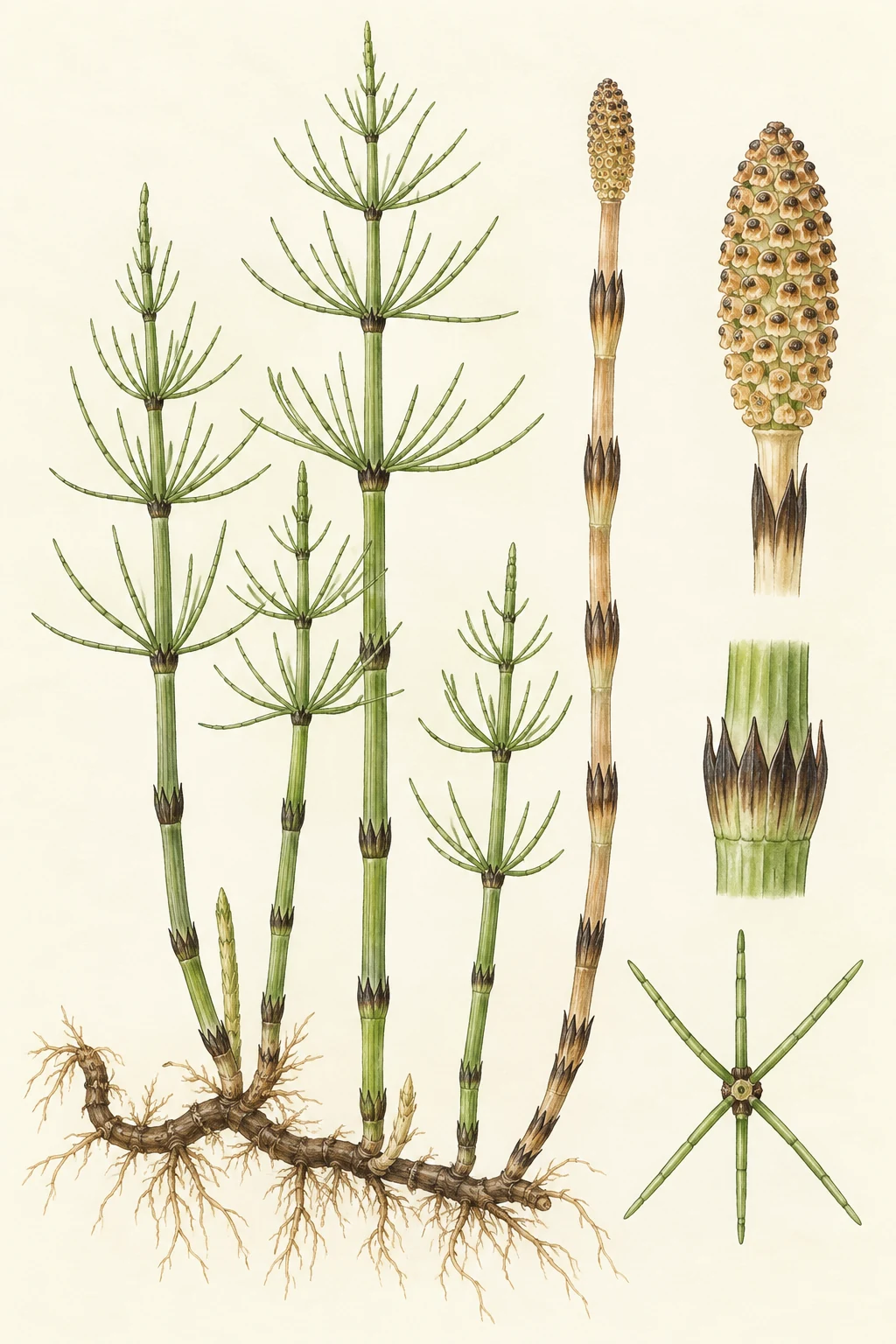
A perennial plant 20 to 60 cm tall.
- Stem
- It has a sterile stem and a fertile stem. The green sterile stems grow from an underground rhizome that multiplies quickly. At their nodes, they bear whorls of slender branches, four-sided in cross-section, shaped like a four-pointed star.
- Leaves
- In both cases, the leaves are simple collars located at the nodes of the stems and branches, in the form of a short, toothed sheath. In this species, the sheath bears 6 to 12 dark teeth.
- Spore cone
- The fertile stems bear an oblong terminal cone made up of sporangiophores (structures bearing sporangia) arranged in whorls and stalked; they produce green spores.
- Do not confuse with
- Be careful not to confuse it with the other horsetails, which can be toxic. Marsh horsetail, in particular, contains very toxic alkaloids. In spring, the stems of field horsetail point upward, while those of the others point downward. Field horsetail (Equisetum arvense) stands out mainly by its side branches, which are usually longer, thinner and spreading, with a sheath whose teeth are shorter than the first segment of the branch; the brownish fertile stems bearing the cone appear separately in spring, before the green stems. Marsh horsetail (Equisetum palustre) has shorter, upright branches and, above all, a sheath whose teeth are often as long as or longer than the first segment of the branch; the cone can sit at the top of a branched green stem.
Field horsetail in the garden
- Sun exposure
- Sun or partial shade
- Soil
- Cool to moist, rather acidic to neutral, often clay or sandy
Sources
- Plant profiles from the course “Wild Medicinal Plants”, eJardin Academy