
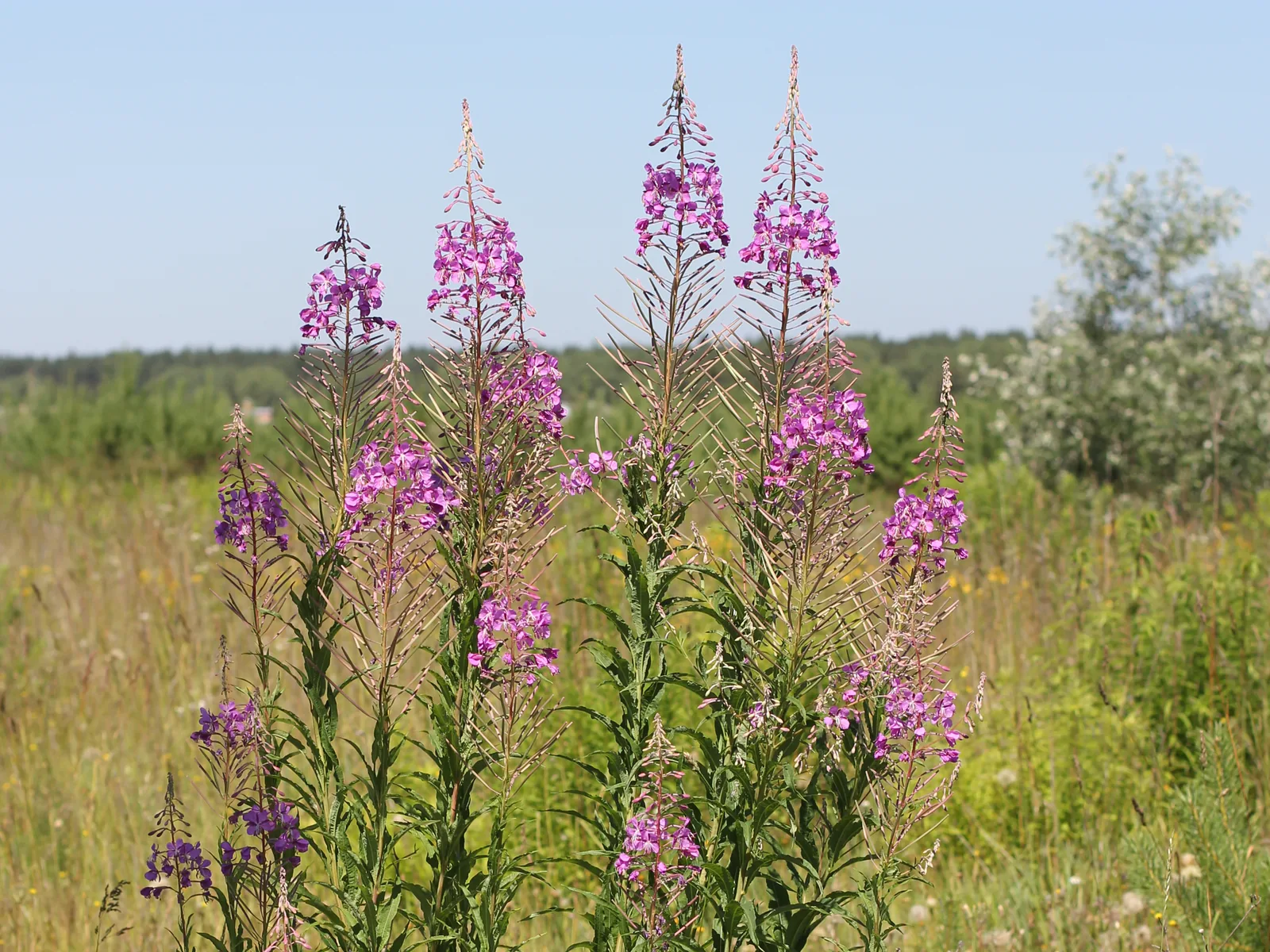
Fireweed
Epilobium angustifolium (America), Epilobium parviflorum (Europe)
rosebay willowherb, great willowherb
Reviewed by Églantine Vignon, Master Herbalist, on
How to identify fireweed
What to check before harvesting or using it.

A perennial plant 0.5 to 2.5 m tall.
- Leaves
- The leaves are many but loosely spaced (scattered), alternate, stalkless, smooth-edged, lance-shaped and very elongated. Their edges are often partly rolled under and their veins form a network.
- Flowers
- The flowers are gathered in long, full clusters at the top of the stem (a symmetrical raceme); they are bright pinkish purple and fairly large (up to 3 cm across). Each flower has 4 spreading petals in a cross, slightly unequal. The 8 stamens and the style curve downward. Four white stigmas also spread out in a cross when mature. The plant flowers from July to August.
Traditional uses of fireweed
- Digestive
- Urinary and renal
- Skin and integumentary
Fireweed can be eaten and drunk. Its young shoots are cooked and its leaves make a gentle herbal tea. It is traditionally used for urinary comfort in men and for digestive comfort, because it is astringent and soothing. As a gargle, it soothes the throat and mouth, and as a compress, minor skin irritations.
Good to know
No particular precautions are reported. If urinary discomfort persists, talk to a health professional.
Fireweed in the garden
- Sun exposure
- Sun or partial shade
- Soil
- Cool to moderately moist, well-drained, rather light to medium
Sources
- Plant profiles from the course “Wild Medicinal Plants”, eJardin Academy