
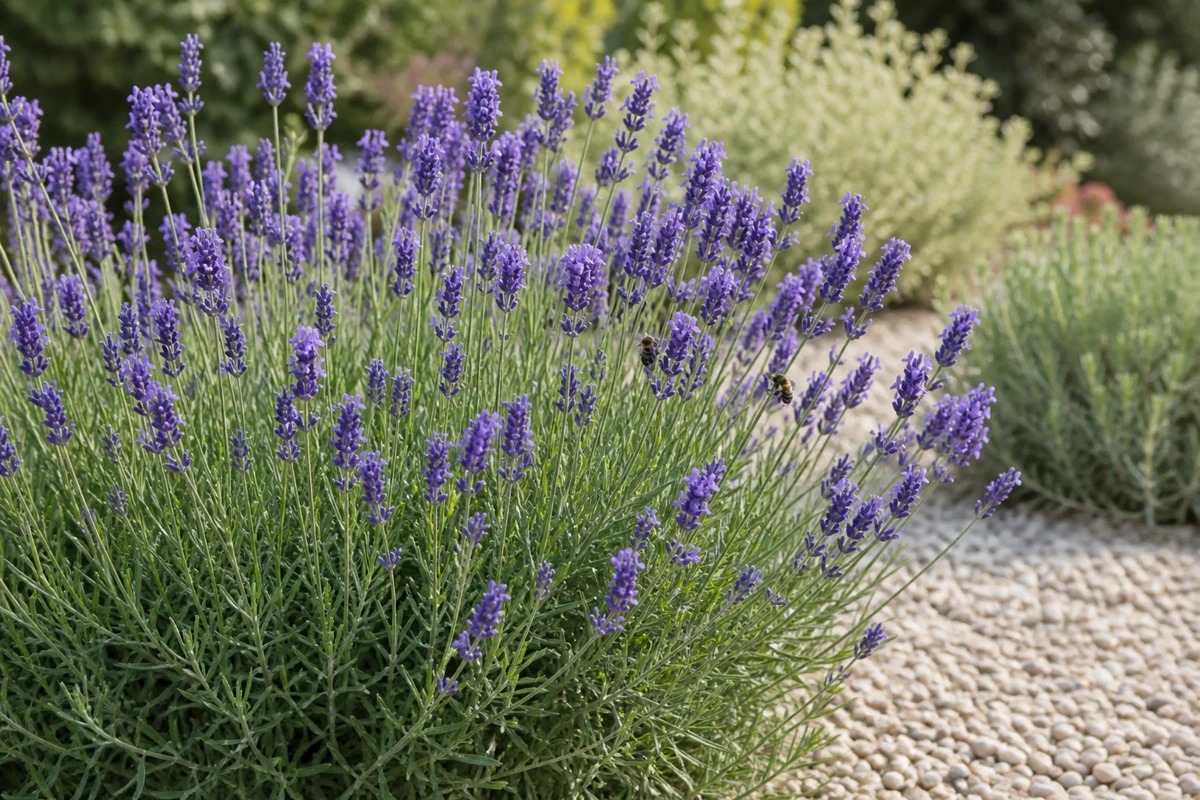
True lavender
Lavandula angustifolia
English lavender, common lavender
Reviewed by Églantine Vignon, Master Herbalist, on
How to identify true lavender
What to check before harvesting or using it.

An aromatic perennial subshrub that forms an evergreen clump. 30 to 80 cm tall, depending on the variety and the soil.
- Stem
- Young stems are square, a typical feature of the Lamiaceae. They become woody and brownish at the base.
- Leaves
- The leaves are opposite, narrow and smooth-edged, a few centimetres long. Grey-green and finely hairy, they are aromatic and their edges are often slightly rolled under.
- Flowers
- The small two-lipped tubular flowers range from violet-blue to mauve, depending on the variety. They are grouped in tight whorls that form a compact spike, at the end of a long, almost leafless flower stalk that is usually unbranched. Each flower stays surrounded by a persistent calyx.
- Do not confuse with
- Lavandin (Lavandula × intermedia) is a hybrid of true lavender and Lavandula latifolia. It is taller and its scent is stronger and camphor-like. Its flower stalks branch and often carry 2 or 3 spikes. Spanish lavender (Lavandula stoechas) has large coloured bracts standing upright at the top of the spike. On a label, only the Latin name tells you which lavender it is.
Traditional uses of true lavender
- Nervous
- Skin and integumentary
True lavender is above all associated with relaxation and sleep. It is said to be calming when stress builds up or sleep is slow to come. Well diluted, its essential oil is also used in some skin care and to ease muscle tension. In everyday life, it turns up in the kitchen and in small sachets that scent the linen.
Good to know
Its essential oil is highly concentrated: it is not swallowed and is always applied diluted. For children, or during pregnancy or breastfeeding, ask for advice before using it.
Sources
- eJardin Plant Guide, text by Églantine Vignon