
Common purslane
Portulaca oleracea
garden purslane, wild purslane
Reviewed by Églantine Vignon, Master Herbalist, on
How to identify common purslane
What to check before harvesting or using it.

Purslane is a very common succulent annual, able to grow in sidewalk cracks, along roadsides, on vacant lots and around gardens.
- Stem
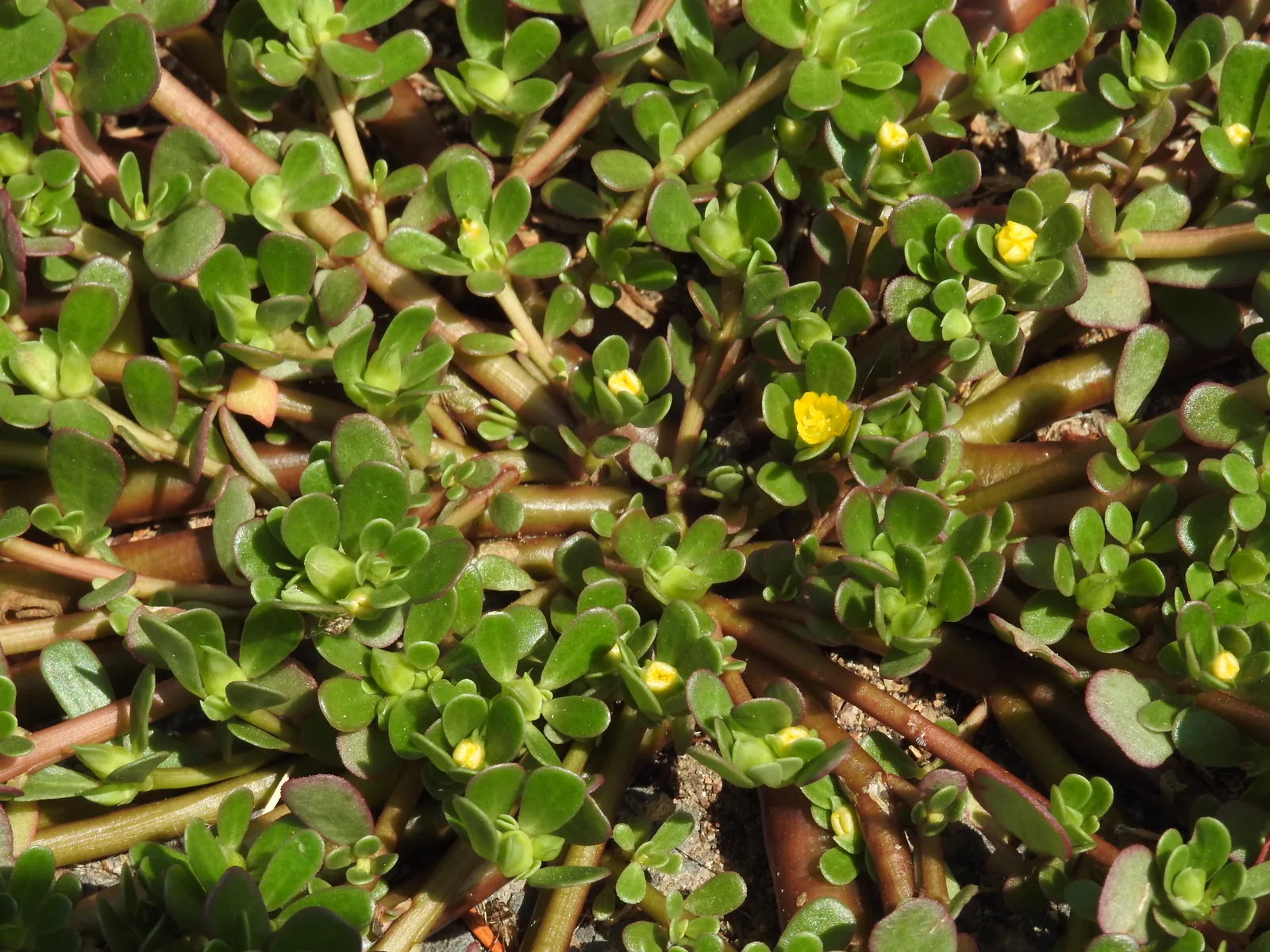
- It grows flat along the ground, with cylindrical, fleshy, smooth, often reddish stems that branch out over the soil and can reach 30 to 40 centimetres long.
- Leaves
- Its leaves are fleshy, smooth and glossy like those of a succulent; they are usually oval or spoon-shaped, simple, alternate or nearly opposite, and often clustered toward the ends of the stems.
- Flowers
- The small yellow star-shaped flowers, with five to six petals, open only in the morning and appear singly or in small groups where the leaves join the stem or at the stem tips.
- Do not confuse with
- Spotted spurge grows in the same places as purslane and also spreads along the ground. Spurge has thin, hairy stems and small opposite leaves often marked with a purple spot, and it oozes an irritating white latex when the stem is broken. As with other annual spurges, its flowers are greenish and its leaves are not fleshy. Purslane has fleshy, smooth stems with no latex, and yellow flowers.
Traditional uses of common purslane
- Digestive
- Skin and integumentary
- Immune and lymphatic
Purslane is first and foremost a wild vegetable. Its fleshy, slightly tangy leaves contain omega-3s, something rare in leafy greens. Tradition associates it with digestive comfort, thanks to its mucilages, and with the health of the heart and blood vessels. Externally, it is applied to minor wounds or insect bites.
Good to know
Because it is rich in oxalates, limit it if you have kidney stones, gout or kidney disease.
Sources
- Plant profiles from the course “Managing Garden Weeds as Valuable Allies”, eJardin Academy