
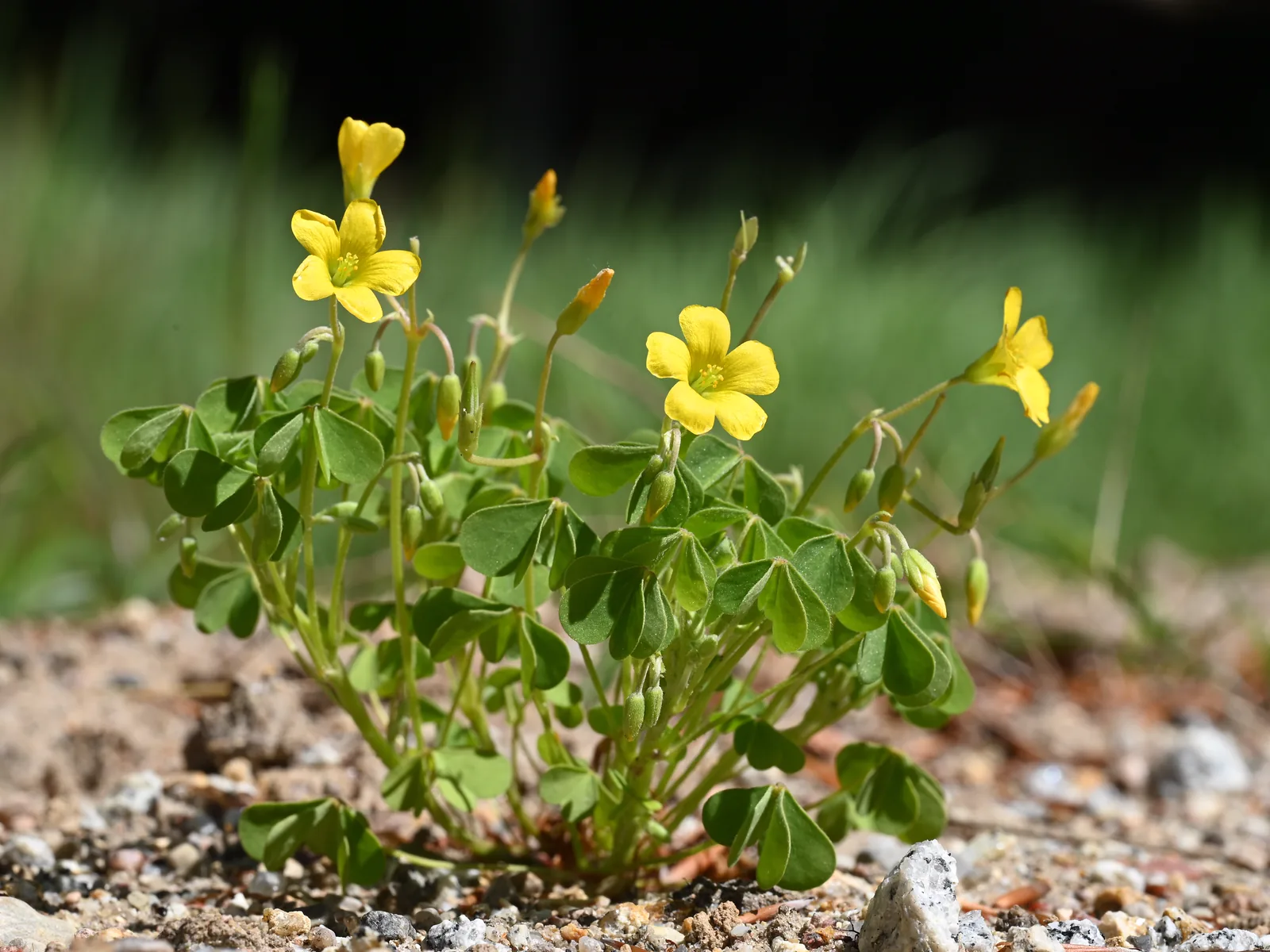
Upright yellow woodsorrel
Oxalis stricta
common yellow woodsorrel, sourgrass, European woodsorrel
Reviewed by Églantine Vignon, Master Herbalist, on
How to identify upright yellow woodsorrel
What to check before harvesting or using it.

Upright yellow woodsorrel is a small plant of cool, shady woodlands, but also of pastures, disturbed ground, gardens, fields and slightly acidic lawns.
- Stem
- The upright, branching stem is about 5 to 30 centimetres tall; it is green, sometimes purplish, and the whole plant carries scattered jointed hairs.
- Leaves
- Its pale to bright green leaves have three heart-shaped leaflets, each marked by a central line as if it had been folded in two.
- Flowers
- The yellow five-petalled flowers are carried on a long stalk, often in pairs or in small umbrella-like clusters (cymes) of two to four flowers.
- Fruit
- Narrow, angular, upright capsules. When ripe, they burst open at the slightest touch and fling out their small brown seeds.
- Do not confuse with
- Mountain woodsorrel (Oxalis montana) is recognized by its pink flowers. Without flowers, woodsorrel can be mistaken for white clover (Trifolium repens), whose leaflets carry small pale markings and are rounded, not heart-shaped.
Traditional uses of upright yellow woodsorrel
- Digestive
- Urinary and renal
Its tangy leaves can be nibbled in small amounts and liven up a salad. Tradition links woodsorrel to digestion, for more regular bowel movements, and its vitamin C gives the body's defences a small boost. As a poultice, it soothes minor skin irritations.
Good to know
It is rich in oxalic acid: if you have kidney stones, gout or joint problems, avoid it completely.
Sources
- Plant profiles from the course “Managing Garden Weeds as Valuable Allies”, eJardin Academy