
Lamb's quarters
Chenopodium album
wild spinach, white goosefoot, fat hen, melde, pigweed
Based on the courses of Églantine Vignon, Master Herbalist Updated
How to identify lamb's quarters
What to check before harvesting or using it.

Lamb's quarters is a very common annual of vacant lots, gardens, cultivated fields, the bases of walls and roadsides.
- Stem
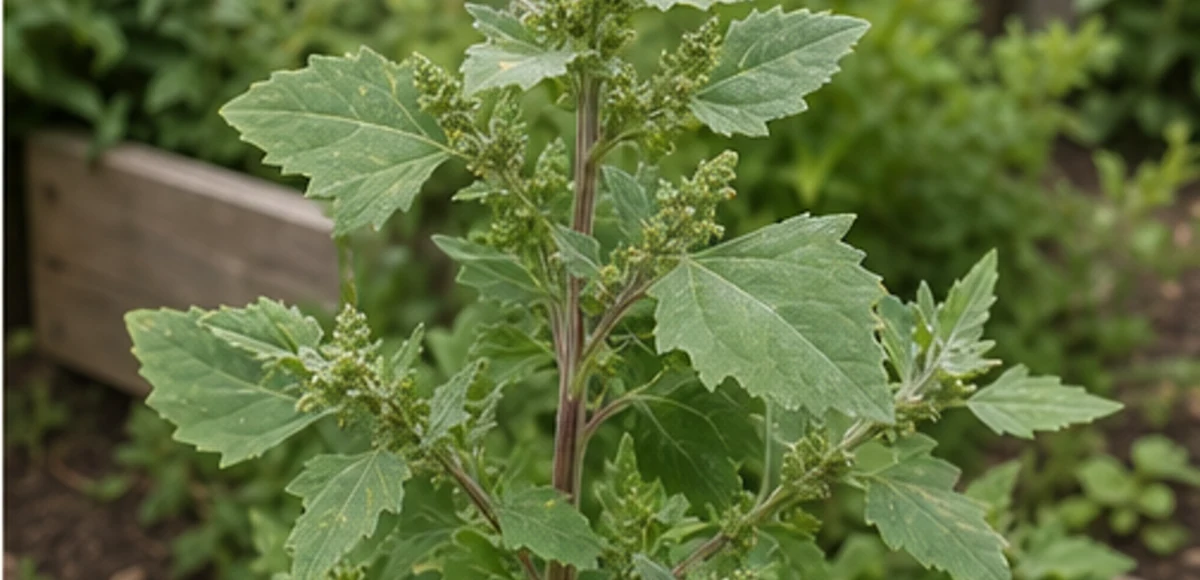
- Its upright, often branched stem measures 20 to 150 centimetres; it is striated or grooved, green to reddish, and sometimes becomes angular, yellowish and mealy at maturity.
- Leaves
- Its alternate, stalked leaves vary greatly in shape, from triangular to oval or elliptic, with an entire or irregularly toothed margin. They are light green above, silvery white underneath, and covered with a mealy bloom that feels damp to the touch.
- Flowers
- The flowers, very small, greenish white and without petals, are grouped in panicles at the top of the stem.
- Fruit
- Each fruit contains a single, almost round seed, flattened on one side like a lentil, black and glossy, about 1 mm across.
- Do not confuse with
- Spear-leaved orache (Atriplex patula) has a stem branched from the base and triangular leaves. Its flowers are in spikes, the female ones surrounded by bracts, and the plant is less mealy. Fig-leaved goosefoot (Chenopodium ficifolium) has more elongated leaves, with two lobes at the base. Common ragweed (Ambrosia artemisiifolia) has more deeply toothed leaves; it is not edible.
Sources
- Plant profiles from the course “Managing Garden Weeds as Valuable Allies”, eJardin Academy