
Common sow-thistle
Sonchus oleraceus
smooth sow-thistle, annual sow-thistle
Based on the courses of Églantine Vignon, Master Herbalist Updated
How to identify common sow-thistle
What to check before harvesting or using it.

Common sow-thistle is an annual or biennial of vegetable gardens, cultivated fields, urban wasteland, vacant lots and pathsides, fond of loose, nitrogen-rich, sunny soils.
- Stem
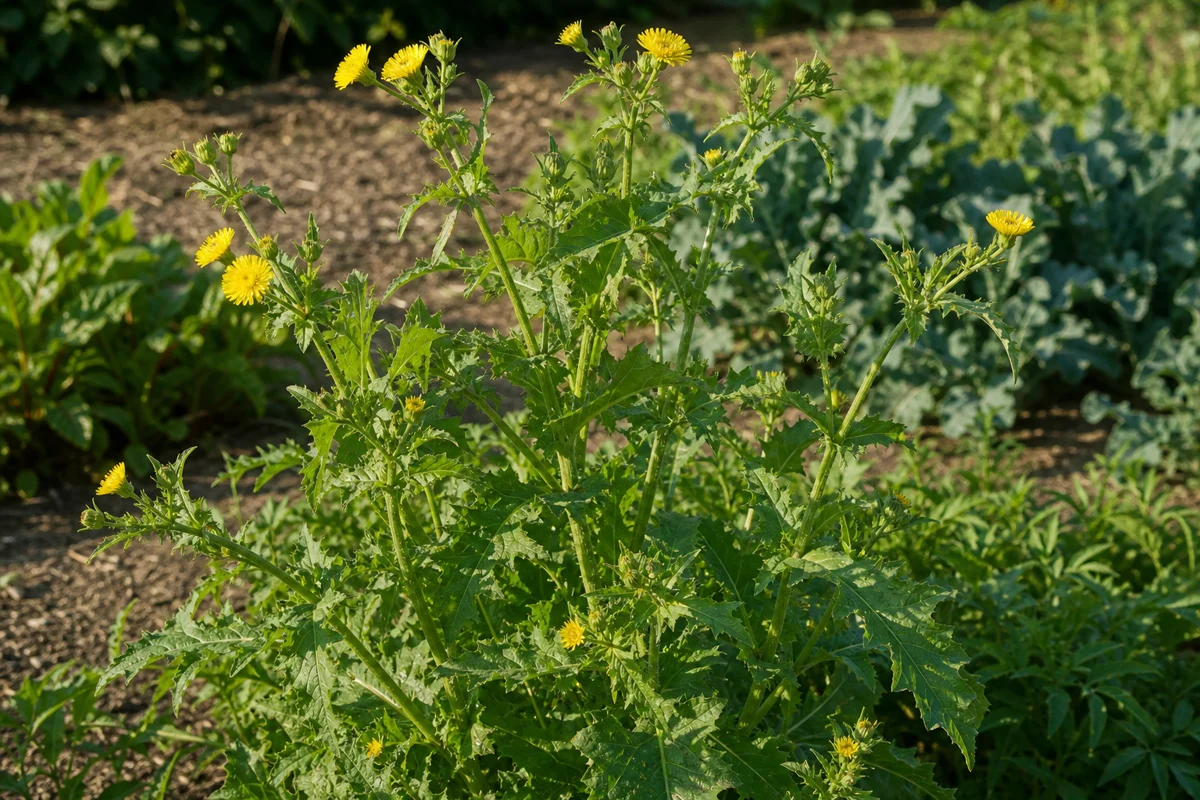
- The stem is upright, hollow, hairless and branched, and contains a milky white latex; it measures about 30 to 100 centimetres.
- Leaves
- Its young leaves form a basal rosette, followed by alternate, glossy leaves, light to dark green, deeply cut and clasping the stem with small lobes at the base.
- Flowers
- The yellow flower heads, similar to those of the dandelion, measure 2 to 3 centimetres and are arranged in terminal corymbs from May to October.
- Fruit
- The seeds are small and light brown. Each carries a tuft of silky hairs that lets it travel on the wind.
- Do not confuse with
- Spiny sow-thistle (Sonchus asper) has thicker, glossy and very spiny leaves. Dandelion (Taraxacum officinale) has similar flowers, but its leaves stay in a rosette at the base: its flowering stem bears no leaves. Chicory (Cichorium intybus) has blue flowers, a stiffer habit and hairy stems.
Sources
- Plant profiles from the course “Managing Garden Weeds as Valuable Allies”, eJardin Academy