
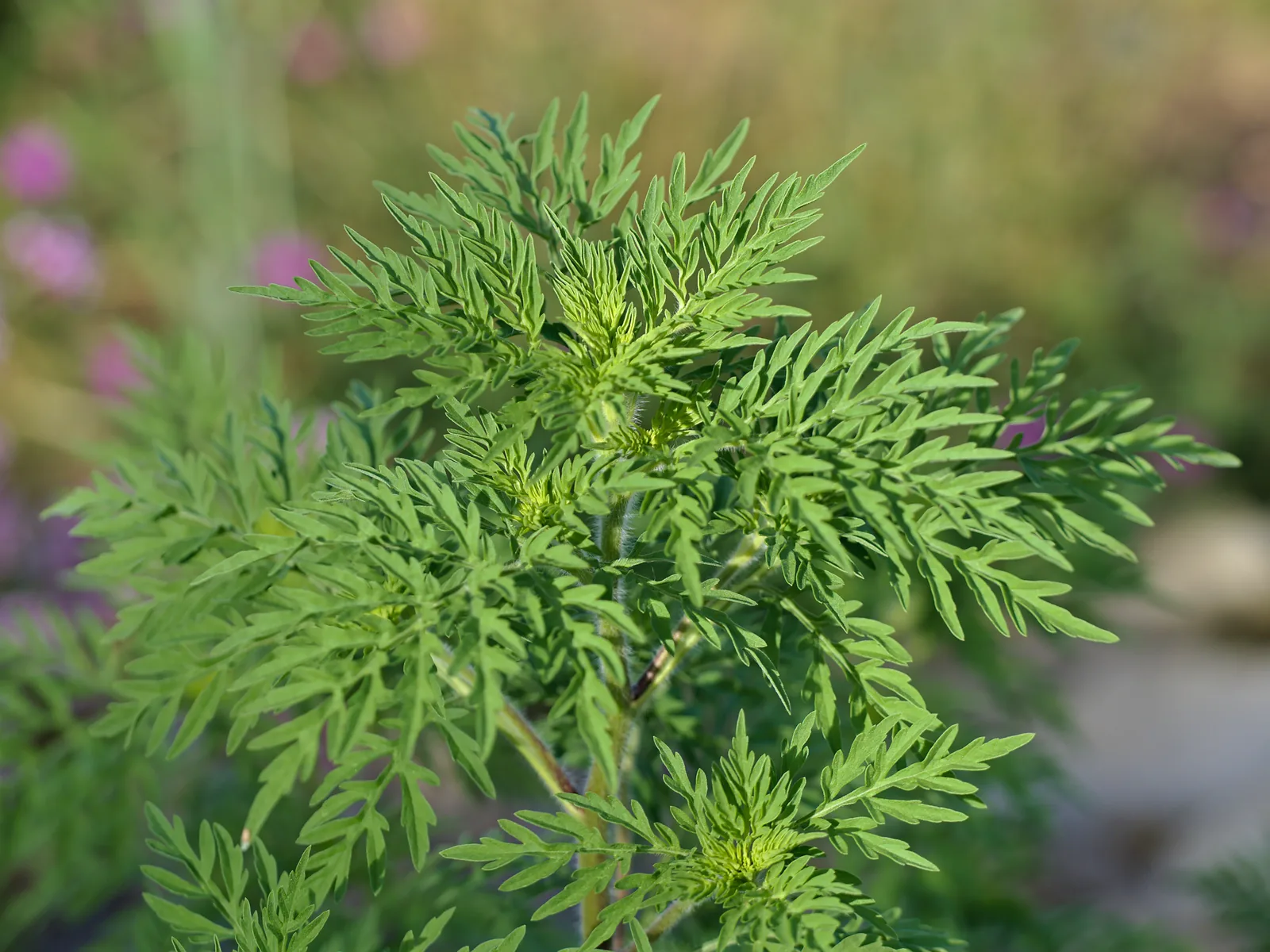
Common ragweed
Ambrosia artemisiifolia
small ragweed, St. Prime's herb
Based on the courses of Églantine Vignon, Master Herbalist Updated
How to identify common ragweed
What to check before harvesting or using it.

Common ragweed is an upright, branched annual, sometimes reddish, that can exceed 1.5 metres in height and readily grows on bare ground, wasteland, near paths and between sidewalks.
- Leaves
- Its deeply cut leaves are reminiscent of carrot tops: they are opposite at the bottom, then alternate higher up, dark green above and paler, slightly hairy underneath.
- Flowers
- The numerous, greenish male flowers are at the top, in spikes arranged in a panicle, while the more inconspicuous female flowers sit below them, in the leaf axils.
- Fruit
- The fruits are small oval achenes, ending in a central beak surrounded by a ring of small spines. Each plant produces thousands of them.
- Roots
- A main taproot, along with finer roots that spread out. It goes down deep, which makes the plant hard to pull up.
- Do not confuse with
- Common mugwort (Artemisia vulgaris) looks very similar and grows in the same habitats. Common ragweed is distinguished from mugwort by its dense hairiness and by the underside of its leaves, which is not silvery. Giant ragweed (Ambrosia trifida) also looks similar, but it is taller and its leaves are less deeply cut.
Sources
- Plant profiles from the course “Managing Garden Weeds as Valuable Allies”, eJardin Academy