
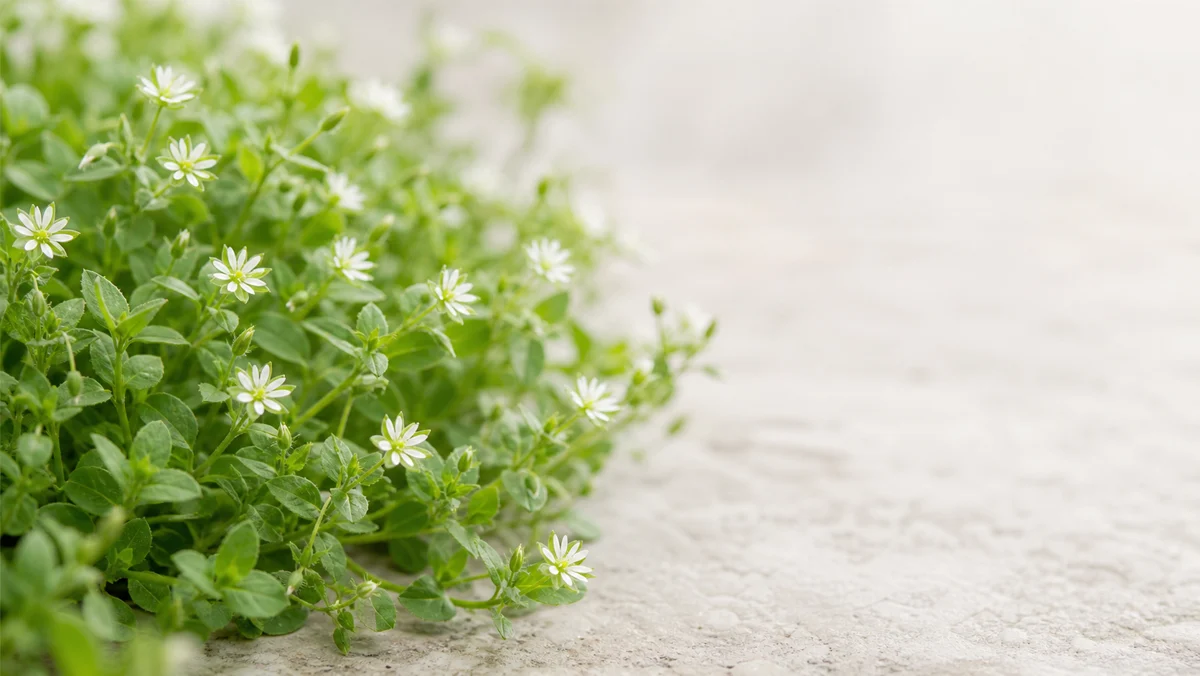
Common chickweed
Stellaria media
chickweed, starwort, winterweed
Based on the courses of Églantine Vignon, Master Herbalist Updated
How to identify common chickweed
What to check before harvesting or using it.

Common chickweed is an annual of gardens, vegetable plots, lawns and fields, typical of rich, moist soils with plenty of organic matter; it prefers shade and does not tolerate drought and strong heat well.
- Stem
- It forms dense mats and a ground cover of creeping, sometimes ascending stems 5 to 60 centimetres long. The round stems carry a single line of hairs on one side and root at the nodes; when gently pinched, they reveal a taut central cord.
- Leaves
- The opposite leaves are entire, oval and rounded at the base; the lower ones have a stalk fringed with hairs, while the upper ones are sessile and hairless.
- Flowers
- The small, white, star-shaped flowers are solitary or in terminal cymes, with five deeply divided petals, slightly shorter than the hairy sepals.
- Fruit
- The fruit is a small ovoid capsule, barely longer than the sepals, which opens at the top by six teeth. It contains 8 to 10 yellowish to dark brown seeds, oval and covered with small bumps.
- Do not confuse with
- Grass-leaved stitchwort (Stellaria graminea) is distinguished by its square stem, its narrow, stalkless leaves and its longer petals. Common mouse-ear chickweed (Cerastium fontanum) also looks similar, but its stem and leaves are very hairy.
Sources
- Plant profiles from the course “Managing Garden Weeds as Valuable Allies”, eJardin Academy